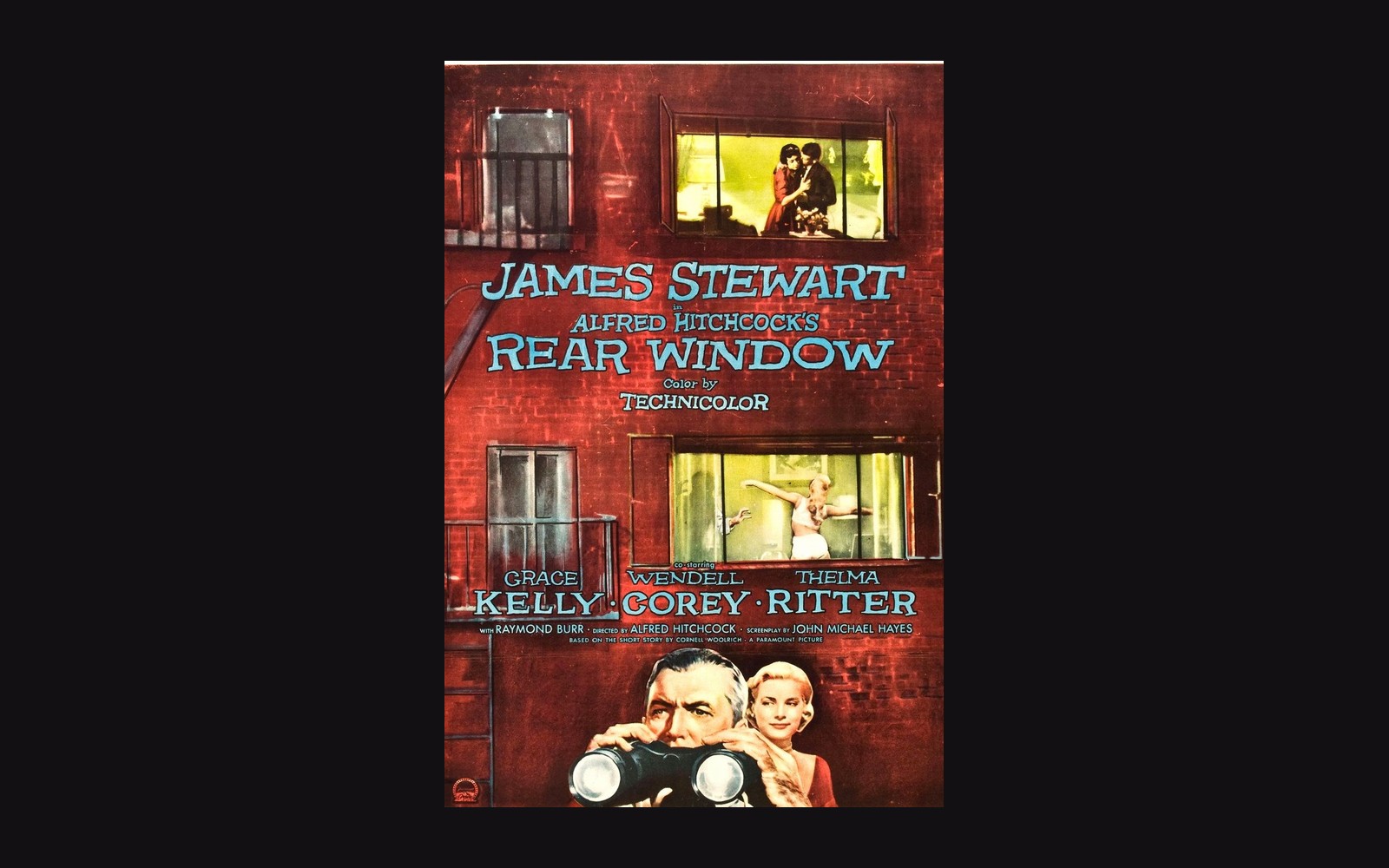
A short story's copyright revival ended the Hitchcock film's commercial life for eight years — and rewrote the rules for derivative works across the American film industry.
The Lawsuit Hidden Inside a Hitchcock Classic
Alfred Hitchcock's Rear Window (1954) is among the most studied films in the American canon. Its copyright history is equally instructive, though far less celebrated. The Supreme Court's 1990 decision in Stewart v. Abend, 495 U.S. 207, turned the film into the definitive legal illustration of a problem that had quietly threatened Hollywood adaptations for decades: what happens when the underlying work's copyright outlasts the film built on top of it?
 04.05
04.05The story begins with Cornell Woolrich, who published a short story called "It Had to Be Murder" in Dime Detective Magazine in 1942. Woolrich registered the copyright and, before his death in 1968, assigned the renewal rights to his literary agent, Sheldon Abend. Because Woolrich died before the renewal term began, the earlier assignment did not bind the renewal term, which passed to his executor as statutory successor, and Abend acquired the renewal rights from the executor. Abend duly renewed the copyright in 1969. Meanwhile, Hitchcock and actor James Stewart had already acquired rights to the story, made the film, and — along with the film's producer — held whatever rights they had negotiated. When Abend sought to block MCA from re-releasing Rear Window in theaters and on home video in the 1970s and 1980s, a direct collision between the film's commercial future and the underlying story's renewed copyright became inevitable.
What the Court Decided — and Why It Matters
The Supreme Court's ruling in Stewart v. Abend resolved a circuit split and established a principle with permanent consequences. In a 6–3 decision written by Justice Sandra Day O'Connor, the Court held that the owner of a renewal copyright in an underlying work can prevent the continued distribution of a derivative work — here, the film — even if the derivative work's creators had a valid license during the original copyright term. When an author dies before the renewal term vests and a successor acquires the renewal right, that successor is not bound by any licenses the original author granted. The renewal right, the Court reasoned, is a distinct statutory entitlement under the Copyright Act of 1909, not a mere extension of the original term.
This is the crux of what practitioners call the "derivative works trap." A film studio could acquire rights in good faith, invest substantially in production, and hold an apparently valid license — and still find itself infringing the moment the original copyright renewed in hands that had never agreed to anything. The Court acknowledged the hardship this created for derivative-work owners but declined to invent a judicial exception. Congress had structured the renewal mechanism precisely to give authors and their heirs a second bite, and the Court was unwilling to override that design through interpretation.
The practical consequence was immediate: Rear Window was effectively locked out of legitimate commercial distribution until 1991, when Abend and the film's rights holders negotiated a settlement. The film had sat largely unavailable for eight years — a real commercial loss for a major studio title, and a vivid demonstration of how copyright doctrine can immobilize cultural works that everyone assumes are freely circulating.
Reading the Decision Through the Copyright Office Record
Understanding Stewart v. Abend requires reading two layers of the Copyright Office record simultaneously: the registration and renewal of the underlying short story, and the registration of the film as a derivative work. Researchers can trace both through the Copyright Office's Catalog of Copyright Entries, which covers registrations and renewals through 1978, after which electronic records are searchable in the Copyright Office's online catalog.
The 1909 Act, which governed works published before January 1, 1978, provided a first term of twenty-eight years and a renewable second term of equal length — later extended, first by the 1976 Act and then by the Sonny Bono Copyright Term Extension Act of 1998, which set the ninety-five-year maximum now familiar to researchers. Under the 1909 Act's scheme, the renewal right was personal to the author or, if the author was dead, to specified statutory successors. Assignment of the renewal right during the original term was treated by the Court as a contingent contract: if the author survived to the renewal year, the assignee's rights were enforceable; if the author died first, the contract had nothing to convey.
This principle had already been established in Miller Music Corp. v. Charles N. Daniels, Inc., 362 U.S. 373 (1960), and the Stewart Court applied it with full force to the film-adaptation context. What Stewart added was clarity about the downstream effect on derivative works: the derivative work's author cannot distribute that work during the underlying work's renewal term without the renewal-right holder's permission, even if the original license would otherwise have covered the entire duration of copyright.
The Doctrine's Reach Beyond Rear Window
Stewart v. Abend did not arise in a vacuum. Hollywood had adapted thousands of novels, plays, and short stories under the 1909 Act's regime, and a substantial fraction of those underlying works were authored by people who did not survive to the renewal year. Every such adaptation carried — and in some cases still carries — potential exposure. The decision prompted studios to audit their libraries for exactly this vulnerability, checking renewal records against the original author's date of death and the identity of whoever filed the renewal.
The ruling also sharpened the already-important distinction between a derivative work's own copyright and the copyright in the underlying material. A film based on a public-domain source owns its original creative contributions — cinematography, script elaboration, performance — but the derivative-work copyright does not insulate the film from underlying rights it never controlled. Conversely, a film adaptation of a properly licensed work is not automatically safe if the author's death scrambles the renewal succession. These are separate questions that require separate inquiries, and Stewart made clear that conflating them is a doctrinal error with commercial consequences.
For archivists and documentary makers, the case is a standing reminder that a film's apparent public-domain status — or its freedom from challenge — must be assessed against the underlying literary or musical source, not just the film registration itself. A film may have entered the public domain through failure to renew, while the short story it adapts remains protected under a timely renewal filed by a statutory successor. In that scenario, a free film still carries obligations to a living copyright in the source material, and distribution without a license remains infringement. The Copyright Office's guidance on registration and recordation is the starting point for untangling such layered claims.
Rear Window was eventually restored to distribution after settlement and remains commercially available. But the eight years of its effective suppression gave the legal principle teeth that an abstract ruling alone might never have provided. The decision stands as the Supreme Court's most direct statement on derivative-work rights under the renewal system — and a case that any researcher working with adapted films under the 1909 Act's shadow must know cold.