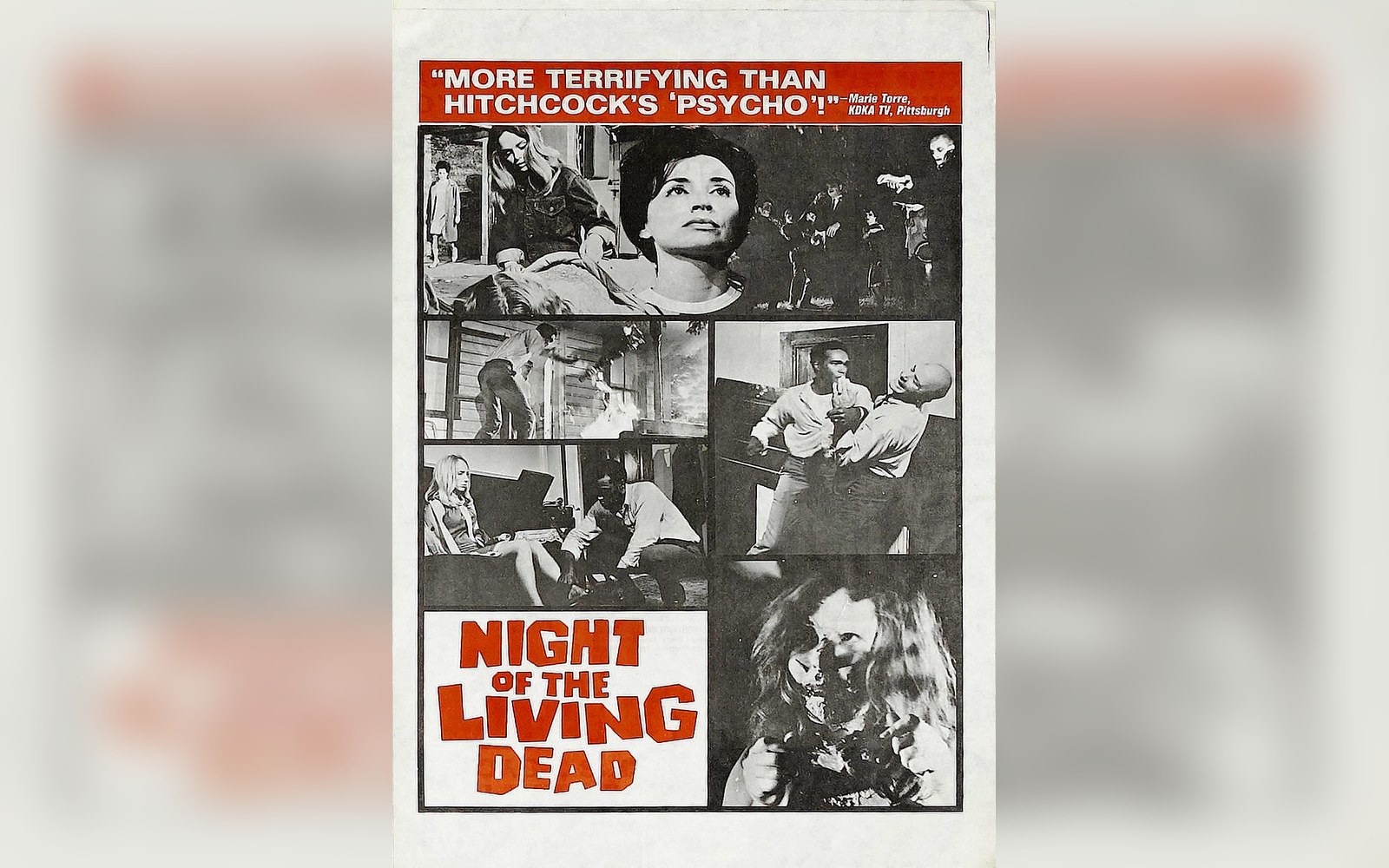
The copyright notice on a film released before 1989 was not a formality. It was a condition. Under the Copyright Act of 1909, which still governed works published before the 1976 Act's reforms took effect, a motion picture that reached the public without a proper statutory notice — the © symbol or the word "Copyright," the year of first publication, and the name of the copyright proprietor — was not merely unprotected pending later registration. It was immediately and irrevocably surrendered to the public domain. No subsequent filing, no corrected print, no contractual claim could pull it back. The moment of publication without notice was the moment of forfeiture, and it could not be undone.
That is precisely what happened to Night of the Living Dead in October 1968, and the mechanism was not negligence on the part of George Romero or his producing partners at Image Ten. It was a title-card substitution made by the Walter Reade Organization, the New York-based distribution company that acquired the film for national release.
The Title Card That Changed Everything
 02.01
02.01Image Ten had completed the film — shot in and around Evans City, Pennsylvania, on a modest budget — under the working title Night of the Flesh Eaters. When Walter Reade Organization prepared to distribute it, the company discovered that Allied Artists had already released a different film carrying that title. A replacement was required, and quickly. The distributor created a new main-title card reading Night of the Living Dead and spliced it into prints before they went out to theaters.
The original title card had carried a copyright notice. The replacement card did not. Whether this was an oversight in the rush to get prints into circulation, or simply a failure to appreciate what the 1909 Act demanded, is not documented in any surviving business record known to archivists. What is documented is the result: the film was published without the required copyright notice, and under the governing statute, publication without notice constituted a dedication of the work to the public.
The Copyright Office record confirms the problem. A registration was filed — Certificate of Registration PA 0000009629 — but registration alone, under the 1909 Act framework, could not cure a defective publication. The 1909 Act required that the notice appear on each copy of the work as published. A notice filed at the Copyright Office after the fact, or a registration subsequent to public distribution of noticeless prints, did not restore what the statute had extinguished. This is the central and often misunderstood point: registration and notice were separate requirements serving separate functions, and the failure of one could not be remedied by the presence of the other.
What the 1909 Act Required, and What It Foreclosed
The statutory framework in force in October 1968 derived from Section 10 of the Copyright Act of 1909, which conditioned copyright subsistence on publication with notice. Courts interpreting this provision had consistently held that "publication" meant the distribution of copies to the public, and that each such copy had to carry the notice. A single defective copy in general circulation was sufficient to trigger forfeiture in some circuit-court readings; a systematic distribution of noticeless prints — which is what happened here — left no room for ambiguity.
The 1976 Act, which took effect on 1 January 1978, introduced a cure provision allowing rights holders a five-year window to correct notice omissions under certain conditions, but that provision applied prospectively. Works published before 1978 remained governed by the 1909 Act's unforgiving rule. By the time Congress softened the formality requirements, Night of the Living Dead had been in the public domain for nearly a decade. The Berne Convention Implementation Act of 1988, which eliminated the notice requirement entirely for works published from 1 March 1989 onward, came twenty years too late to matter here.
There was also no route to restoration through the Uruguay Round Agreements Act of 1996. The URAA's copyright restoration mechanism applied to foreign works that had fallen into the US public domain through failure to comply with American formalities — not to domestic American productions. Night of the Living Dead was an American work, made by American producers, first published in the United States. It could not benefit from the provisions that the Supreme Court upheld in Golan v. Holder, 565 U.S. 302 (2012), and nothing in any subsequent legislation has changed that status.
The Record That Researchers Read
Tracing the forfeiture requires working through two primary sources. The Copyright Office's online catalog and the physical volumes of the Catalog of Copyright Entries together allow researchers to locate the registration and confirm its date relative to the film's distribution. Because prints of the film had already reached theaters by the time any registration was processed, the registration post-dates the publication of noticeless copies — the sequence that triggers forfeiture under the 1909 Act's logic.
The second source is the prints themselves. Film archivists and researchers who have examined surviving elements report the absence of a notice on the main title as distributed. The George Eastman Museum holds preservation materials for numerous films of this era; the Library of Congress, through the National Film Registry — to which Night of the Living Dead was added in 1999 — maintains its own archival holdings. Neither institution's cataloguing of the work contradicts the legal status: the film is in the public domain, and has been since its release.
That status accounts for the film's extraordinary afterlife as a commercially exploited public-domain title. From the VHS era onward, dozens of companies have issued copies, often from degraded dupe negatives, without licensing from Romero's estate or Image Ten's successors. The Internet Archive hosts multiple copies. The absence of a controlling rights holder has meant that no single party could enforce quality standards or prevent the circulation of inferior prints — a direct and lasting consequence of three words missing from a title card.
The lesson that archivists and rights researchers draw from the Night of the Living Dead record is blunt: under the 1909 Act, the notice was not paperwork. It was the lock on the door, and if it was not there when the door first opened, the work was free. Permanently.