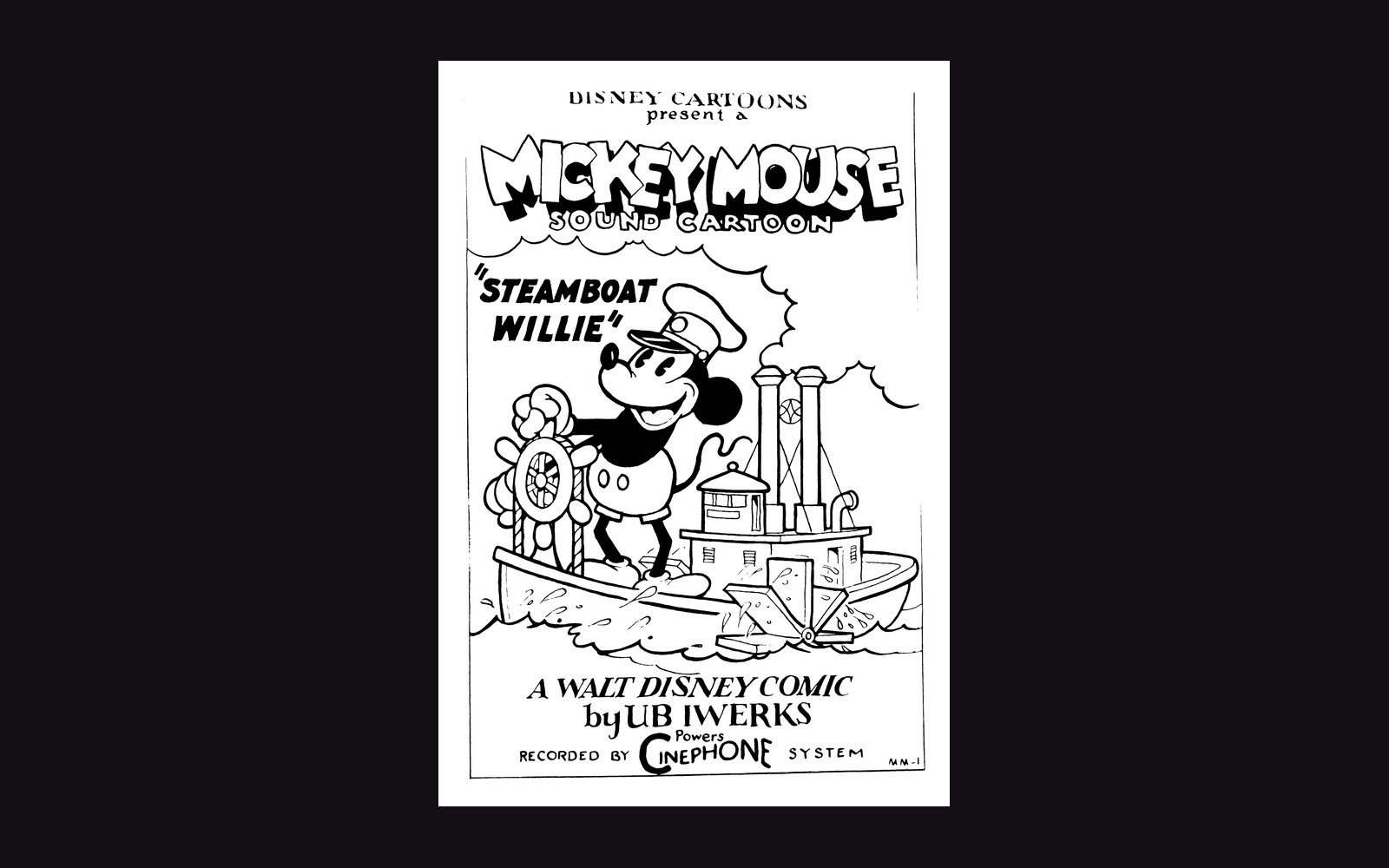
The cartoon is free. The mouse, in all his later forms, is not.
What Entered the Public Domain
On 1 January 2024, Steamboat Willie — the seven-minute Walt Disney synchronized-sound short released on 18 November 1928 — completed its ninety-five-year copyright term under the Sonny Bono Copyright Term Extension Act of 1998 and entered the United States public domain. The short had been registered with the Copyright Office in 1928; its copyright, if properly renewed in the twenty-eighth year, would have carried through the full term the 1998 Act set. That term expired at midnight on 31 December 2023. Beginning 1 January 2024, the 1928 film itself — its specific images, its soundtrack as fixed in that print, its animation — requires no license to reproduce, distribute, or adapt.
 02.02
02.02That is the precise scope of what changed. The date is structural, not ceremonial. Works published in 1928 with valid notice and timely renewal reached the end of their statutory maximum on that morning, and Steamboat Willie was among the most prominent of them.
What Did Not Change
Disney's trademark registrations covering the Mickey Mouse character are a separate legal instrument entirely, governed by the Lanham Act rather than Title 17. A trademark, unlike copyright, does not expire on a fixed schedule; it persists as long as the holder continues to use it in commerce and defends it against dilution. Disney has maintained continuous trademark registrations on Mickey Mouse across apparel, entertainment services, and consumer goods for decades. Those registrations survive the copyright expiration intact.
Equally significant is the distinction between the 1928 version of Mickey Mouse and every subsequent iteration. The character as he appears in Steamboat Willie — a black-and-white figure with particular proportions, a specific set of motions, no white gloves, a somewhat rawer design — is the version that entered the public domain. The Mickey Mouse who acquired white gloves in the early 1930s, who received color in The Band Concert (1935), who was standardized into the globally recognized modern form across decades of subsequent films and merchandise, remains protected. Each of those later films and character designs carries its own copyright term, none of which expired on 1 January 2024. Someone reproducing the 1928 character must take care that their use tracks that specific 1928 design and does not incorporate protected later elements.
Sound recording copyright adds a further complication. The Music Modernization Act of 2018 introduced federal protection for sound recordings fixed before 15 February 1972, which had previously been governed only by state law. Under that statute's transitional provisions, pre-1923 recordings entered the public domain on 1 January 2022; recordings from 1923 through 1946 receive federal protection until 2047. The soundtrack of Steamboat Willie as a synchronized element of the film was fixed in 1928 and is part of the cinematographic work that entered the public domain. Whether the soundtrack is separately actionable as a pre-1972 sound recording under state law — or now federal law — is a question researchers and archivists should assess against the specific jurisdiction and use case, without relying on the film's public-domain status alone as a complete answer.
Reading the Status Correctly
The practical rule is narrow and precise: the audiovisual content of the 1928 theatrical release of Steamboat Willie, as captured in surviving prints, is free of copyright protection in the United States as of 1 January 2024. Any work that builds on that specific film — a remix, a derivative animation, a restored print — should be analyzed on its own terms. A digital restoration may carry its own copyright independent of the underlying material, if the restorer introduced sufficient creative choices.
Disney's response to the expiration was measured. The company noted publicly that its trademark rights remain fully operative and that the expiration applied only to the earliest version of the character. That framing is legally accurate. The Copyright Office's registration records for the 1928 film are the controlling document for the film's status; Disney's trademark portfolio, searchable through the USPTO's trademark search system, is the controlling record for the character's continuing protections. Neither set of records speaks for the other.
Researchers treating 1 January 2024 as a blanket clearance for Mickey Mouse material will find themselves on uncertain ground. Researchers treating it as the precise expiration of copyright in one specific 1928 short film will find themselves on solid footing.