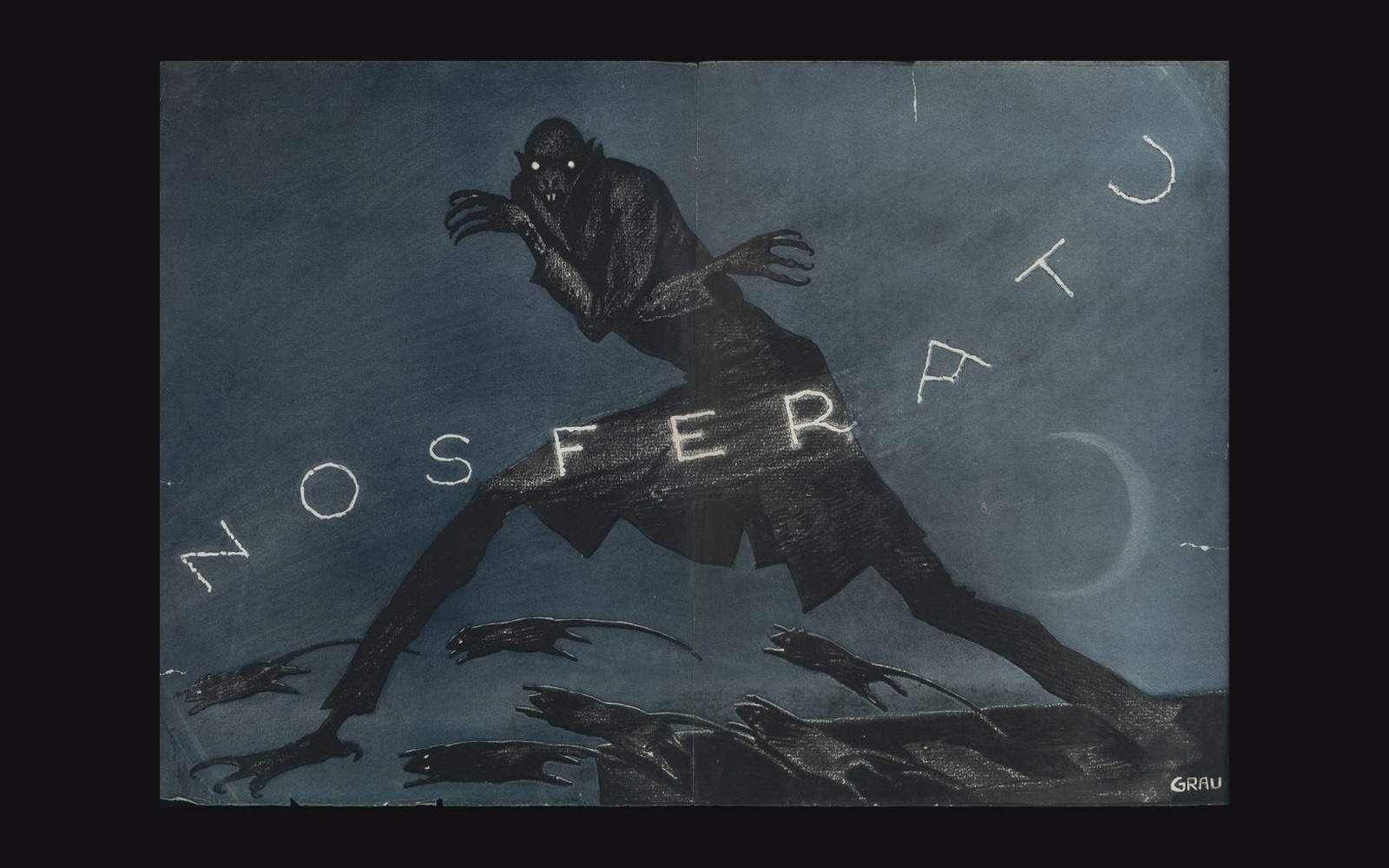
The 1922 Murnau film is unambiguously free in the United States. Its German position is a different calculation entirely.
The American Side: Formality Makes It Simple
F. W. Murnau's Nosferatu, eine Symphonie des Grauens was released in Germany in 1922. Under United States copyright law as it applied to foreign works of that era, protection depended on the same formalities demanded of any film: proper copyright notice on release copies distributed in the United States, and a renewal registration filed with the United States Copyright Office in the twenty-eighth year. Neither condition was met in any legally consequential way. The film circulated in the United States without the statutory notice that pre-1978 law required, and no renewal registration appears in the Catalog of Copyright Entries for the relevant years. The result is a formality failure — copyright, if it ever attached under American law, was not maintained.
 02.09
02.09That analysis made Nosferatu public domain in the United States long before the Sonny Bono Copyright Term Extension Act of 1998 extended maximum terms to ninety-five years. Even under the extended regime, a work that never secured American copyright cannot benefit from it. The Uruguay Round Agreements Act of 1996 (URAA) restored copyright in certain foreign works that had lapsed solely because of American formality failures — but restoration under the URAA required that the work still be protected in its country of origin at the time of restoration. For Nosferatu, the relevant date is 1 January 1996, the URAA's effective date for most works. Whether German law still protected the film at that moment is the crux of the European question.
The German Side: Life-Plus-Seventy and a 1931 Death Date
Murnau died on 11 March 1931 following an automobile accident near Santa Barbara, California. German copyright law, harmonized with European Union standards, protects a personal author's work for seventy years after the author's death — the life-plus-70 term. Applying that term to Murnau, protection under German law would have expired on 31 December 2001. On 1 January 1996, when URAA restoration took effect, the film was therefore still within its German term. That timing appears to satisfy the condition for restoration, which would mean the URAA reinstated American copyright in Nosferatu — with that restored term expiring seventy-five years from the date of first publication, a calculation that points to 31 December 1997 under the formula the Copyright Office applied.
In practice, the restored term would have been short-lived, and the film has been treated as American public domain by archives, distributors, and courts for decades. The Golan v. Holder decision of 2012 confirmed the URAA's constitutionality without resolving every individual title's restoration status; each work must be examined against the record. For Nosferatu, the weight of institutional practice — and the absence of any rights claim successfully asserted against an American distributor — places it firmly in the American public domain.
Print Genealogy and the Bologna Restoration
Copyright status and physical survival are separate problems, and Nosferatu has had a precarious history on both fronts. Prana Film, the production company, went bankrupt after Bram Stoker's estate won a copyright infringement action in Germany in 1925, and a court order called for the destruction of all prints. Several survived through private collectors and early archives, so the film exists today in multiple versions of varying completeness and image quality.
The most authoritative modern text is the restoration carried out by the Cineteca di Bologna, working from the best surviving nitrate elements. Bologna's laboratory, L'Immagine Ritrovata, has become the preeminent address for silent-film restoration in Europe, and its work on Nosferatu produced a version with stabilized image, corrected intertitles, and documented source materials. A restoration of this kind may carry its own copyright as a derivative work, even where the underlying film is free — a distinction that matters when a researcher encounters a Bologna-credited transfer on a commercial release.
The Library of Congress holds preservation elements for the film, and the Internet Archive hosts several digitizations derived from older, pre-Bologna sources. Those older transfers, drawn from circulating prints of uneven provenance, vary substantially in completeness. Researchers sourcing footage for documentary use should treat the Bologna restoration as a separately protected version and consult its credit documentation accordingly.