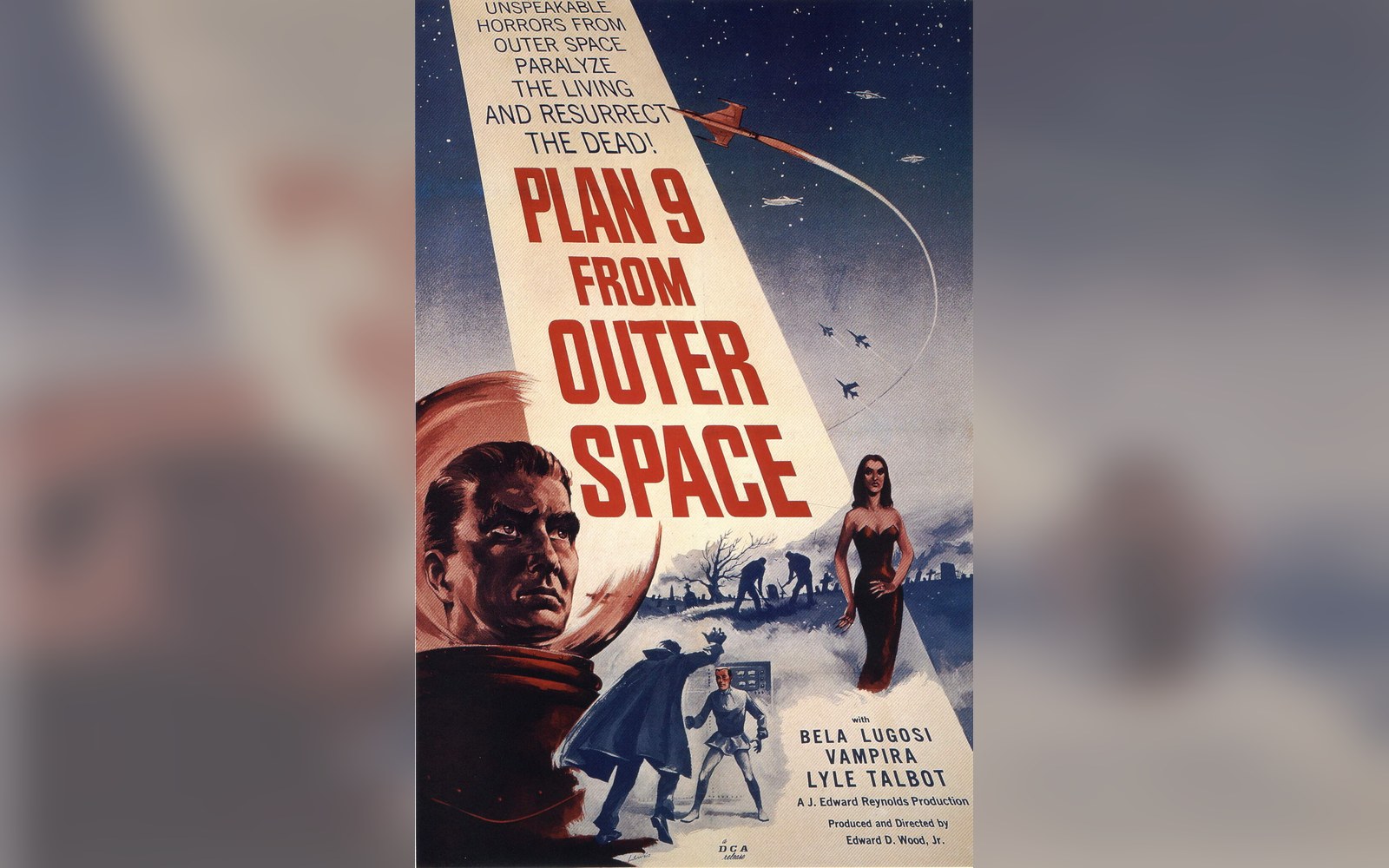
Ed Wood's 1957 science-fiction film is in the public domain not because of its infamy but because its copyright was never properly renewed — a formality failure that shaped how the film was seen for decades.
The Copyright Record
Plan 9 from Outer Space was released in 1957, theatrically distributed in 1959, and registered for copyright under the 1909 Act's framework. Under that regime, a work published before 1964 required a renewal registration filed in the 28th year of the first term to secure a second term of protection. No valid renewal was recorded for Plan 9 in the United States Copyright Office. When the renewal window closed, the film passed irrevocably into the public domain, available without license, royalty, or permission.
 02.08
02.08That single administrative omission — unremarkable in an era when B-picture distributors routinely let renewals lapse — turned out to carry enormous cultural consequences. The film's small production outfit, financed by executive producer J. Edward Reynolds, had neither the infrastructure nor the incentive to manage copyright maintenance on a low-budget science-fiction picture. The result can be confirmed by searching the Copyright Office's Catalog of Copyright Entries, where no renewal for the title appears in the relevant volumes.
How Free Status Made the Film Ubiquitous
Once the public domain position was established, Plan 9 became a staple of the VHS public-domain compilation market and, later, cable access programming. Any broadcaster, duplicator, or distributor could acquire a print and air or sell it without negotiation. The film appeared in countless budget tape compilations packaged alongside other lapsed titles, and its repeated broadcast on regional UHF and early cable channels meant audiences encountered it with a frequency that few B-pictures of comparable quality ever achieved.
That ubiquity preceded and substantially produced the critical mythology. The "worst film ever made" designation — popularized in Michael and Harry Medved's 1980 book The Golden Turkey Awards — spread precisely because the film was already everywhere, already familiar, already cheap enough to ridicule without consequence. The Internet Archive now hosts multiple print variants of the film as part of its moving-image collection, reflecting the degree to which PD status has embedded it in digital preservation workflows.
Separating Status from Legend
The copyright failure is a legal fact; the legend is a cultural construction built on top of it. A better-funded production with an attentive rights department might have renewed on schedule and remained obscure. Instead, the lapse handed the film to everyone at once — and everyone broadcast it. Researchers verifying the film's status should consult the Catalog of Copyright Entries volumes for 1985–1986, the renewal window for a 1957 copyright, and confirm the absence of any filing. The record tells a simpler story than the mythology: a form that was never filed, a fee that was never paid, and a reputation built on access.